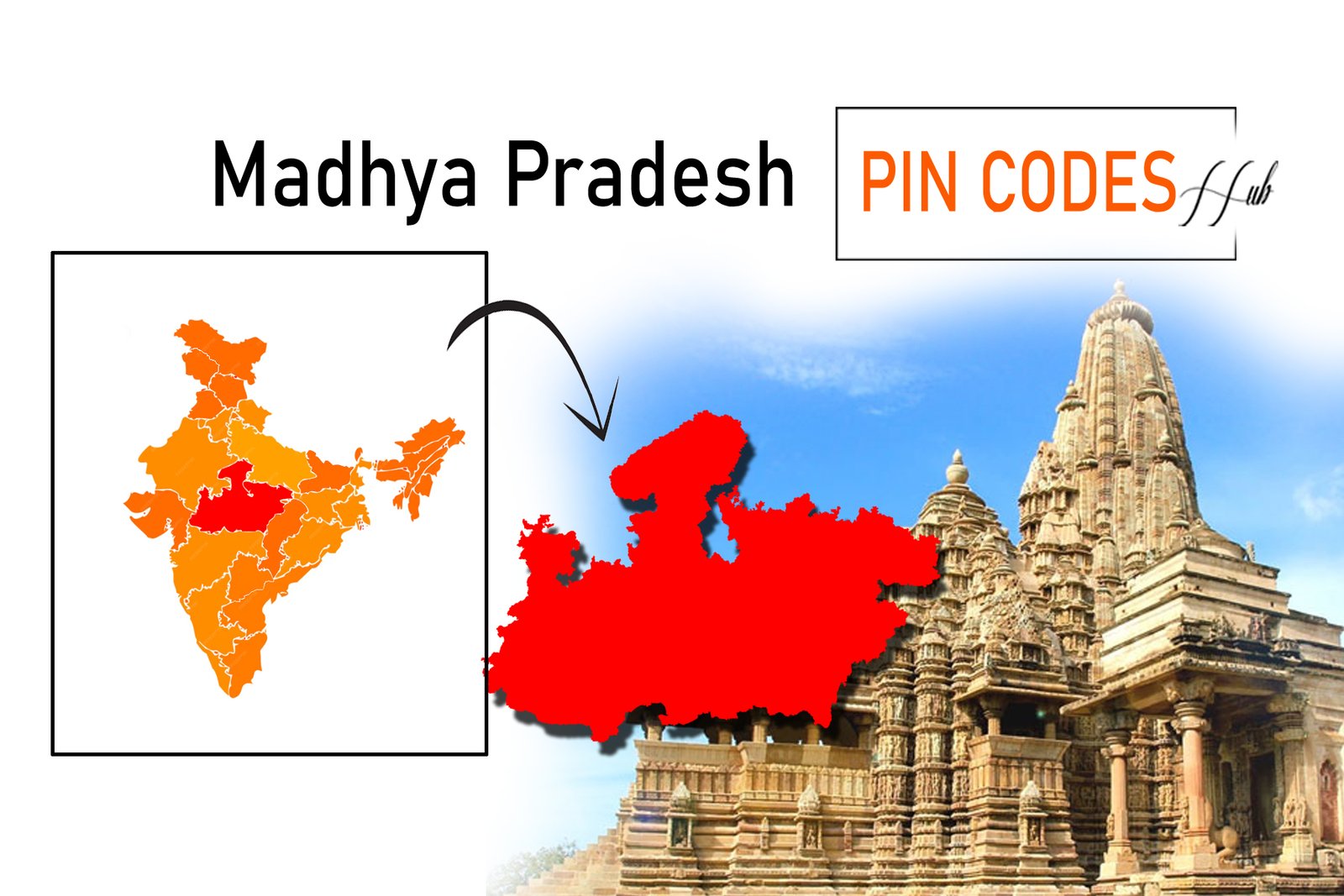
Complete Madhya Pradesh PIN codes Guide:
Madhya Pradesh PIN codes often called the “heart of India,” has a well-organized postal system that connects its vast and diverse regions. From large cities to small villages, the Madhya Pradesh PIN codes system plays an important role in ensuring that letters, parcels, and official documents reach the right destination without confusion. Understanding how PIN codes work in Madhya Pradesh also gives us a glimpse into how structured and widespread the communication network is in the state.
Madhya Pradesh PIN codes , which stands for Postal Index Number, is a six-digit number used by India Post. In Madhya Pradesh, every district, town, and major locality has its own uniqueMadhya Pradesh PIN codes . These numbers are not random; they follow a specific pattern. The first digit represents the region, and Madhya Pradesh falls under the central zone, so its Madhya Pradesh PIN codes usually begin with the number “4.” The second digit narrows it down further to a sub-region, and the third digit represents the sorting district. The last three digits identify the specific post office.
For example, cities like Bhopal, Indore, Jabalpur, and Gwalior all have different Madhya Pradesh PIN codes , but they share the starting digit “4,” showing that they belong to the same postal region. This system helps postal workers quickly identify where a letter needs to go, even before reading the full address.

Madhya Pradesh PIN codes has more than 50 districts, and each district contains multiple post offices, including head post offices, sub-post offices, and branch offices. Larger districts like Indore and Bhopal have a higher number of PIN codes because of their population and urban spread. On the other hand, smaller or more rural districts may have fewer PIN codes, but the system still ensures coverage of even remote areas.
One of the interesting things about Madhya Pradesh PIN codes is how they reflect both geography and administration. For instance, nearby towns often have similar starting digits, making it easier to group them during sorting. In rural areas, branch post offices are connected to a central sub-office, and they share similar PIN code patterns. This layered structure helps manage the delivery process efficiently, even in places where transportation and connectivity can be challenging.
In cities, PIN codes are often used not just for postal services but also for identification purposes in banking, online shopping, and government records. When someone fills out an address form, the PIN code helps automatically identify the city and district, reducing errors. In Madhya Pradesh, this has become especially important with the growth of e-commerce and digital services. Even a small mistake in the PIN code can delay delivery, so people have become more careful about using the correct number.
Madhya Pradesh PIN codes:
| S.No | District | PIN Code (Range / Example) |
|---|---|---|
| 1 | Agar Malwa | 465441 |
| 2 | Alirajpur | 457885–457888 |
| 3 | Anuppur | 484001–484887 |
| 4 | Ashok Nagar | 473330–473446 |
| 5 | Balaghat | 481001–481665 |
| 6 | Barwani | 451551–451881 |
| 7 | Betul | 460001–480441 |
| 8 | Bhind | 477001–477557 |
| 9 | Bhopal | 462001–462066 |
| 10 | Burhanpur | 450331 |
| 11 | Chhatarpur | 471001–471625 |
| 12 | Chhindwara | 480001–480559 |
| 13 | Damoh | 470661–470775 |
| 14 | Datia | 475661 |
| 15 | Dewas | 455001–455227 |
| 16 | Dhar | 454001–454773 |
| 17 | Dindori | 481880 |
| 18 | Guna | 473001–473551 |
| 19 | Gwalior | 474001–474020 |
| 20 | Harda | 461331 |
| 21 | Hoshangabad (Narmadapuram) | 461001 |
| 22 | Indore | 452001–453771 |
| 23 | Jabalpur | 482001–483225 |
| 24 | Jhabua | 457661 |
| 25 | Katni | 483501 |
| 26 | Khandwa (East Nimar) | 450001 |
| 27 | Khargone (West Nimar) | 451001 |
| 28 | Mandla | 481661 |
| 29 | Mandsaur | 458001 |
| 30 | Morena | 476001 |
| 31 | Narsinghpur | 487001 |
| 32 | Neemuch | 458441 |
| 33 | Niwari | 472442 |
| 34 | Panna | 488001 |
| 35 | Raisen | 464551 |
| 36 | Rajgarh | 465661 |
| 37 | Ratlam | 457001 |
| 38 | Rewa | 486001 |
| 39 | Sagar | 470001 |
| 40 | Satna | 485001 |
| 41 | Sehore | 466001 |
| 42 | Seoni | 480661 |
| 43 | Shahdol | 484001 |
| 44 | Shajapur | 465001 |
| 45 | Sheopur | 476337 |
| 46 | Shivpuri | 473551 |
| 47 | Sidhi | 486661 |
| 48 | Singrauli | 486889 |
| 49 | Tikamgarh | 472001 |
| 50 | Ujjain | 456001 |
| 51 | Umaria | 484661 |
| 52 | Vidisha | 464001 |
| 53 | Mauganj (new district) | 486331 |
Another important role of PIN codes is during emergencies and administrative work. Government agencies use PIN codes to organize data, plan services, and identify regions quickly. For example, during health campaigns or disaster relief efforts, areas can be targeted based on their PIN codes. This makes the system not just useful for mail delivery but also for governance and planning.
The history of Madhya Pradesh PIN codes in India dates back to 1972, when the system was introduced to simplify mail sorting and reduce confusion caused by similar place names. In a state like Madhya Pradesh, where many towns and villages may have similar or identical names, the PIN code system has been extremely helpful. It removes ambiguity and ensures that each location is uniquely identified.
In everyday life, people may not think much about Madhya Pradesh PIN codes but they use them regularly. Whether sending a letter, ordering something online, or filling out official forms, the PIN code is always required. In Madhya Pradesh, students, business owners, and even farmers depend on this system for communication and services. For example, a farmer receiving important documents or supplies relies on the correct Madhya Pradesh PIN codes to ensure timely delivery.
Despite its efficiency, the system also faces some challenges. In remote tribal areas or newly developed regions, there may be delays in updating or expanding Madhya Pradesh PIN codes Sometimes, people are not aware of their exact PIN code, which can cause confusion. However, India Post continues to improve its network, and digital tools have made it easier for people to find the correct PIN code for their area.
Overall, the Madhya Pradesh PIN codes is a strong example of how a simple numbering method can support a large and diverse population. It connects cities with villages, supports businesses, and helps government services reach people effectively. Without this system, managing communication in such a large state would be much more difficult.
In conclusion, Madhya Pradesh PIN codes are more than just numbers written at the end of an address. They are an essential part of daily life, quietly working in the background to keep everything connected. From delivering letters to enabling online shopping and administrative planning, they play a vital role in the smooth functioning of the state. Even though people may overlook their importance, Madhya Pradesh PIN codes remain one of the most reliable and organized systems in the country, ensuring that every message finds its way home.
FQ’s Madhya Pradesh PIN codes:
1. Why do different areas in Madhya Pradesh have different PIN codes?
Every area has its own PIN code so that letters and parcels can reach the exact location without confusion. Madhya Pradesh is a large state with many districts, towns, and villages, so giving each area a unique code helps the postal system work smoothly and avoids mistakes in delivery.
2. How can I find the correct PIN code for my area in Madhya Pradesh?
The easiest way is to check at your nearby post office or ask someone locally. Many people also look at old letters, parcels, or official documents where the PIN code is already written. It’s something most people remember after using it a few times.
3. What happens if I write the wrong PIN code on a letter?
If the PIN code is wrong, your letter might get delayed or sent to the wrong place first. Sometimes postal workers can still figure out the correct address, but it takes extra time. So, writing the correct PIN code is always important to avoid delays.
4. Do big cities in Madhya Pradesh have more than one PIN code?
Yes, big cities usually have multiple PIN codes. This is because one single code cannot manage all areas of a large city. Dividing the city into different PIN code zones helps in faster and more organized delivery of mail.
5. Is the PIN code the same for all villages in a district?
Not always. Some nearby villages may share the same PIN code if they are served by the same post office. But in many cases, different villages have different PIN codes depending on how the postal services are arranged in that area.
About Madhya Pradesh PIN codes:
Madhya Pradesh PIN codes is often called the “heart of India,” not just because of its location on the map, but because of the way it quietly connects so many different parts of the country—geographically, culturally, and historically. When you think about this state, it doesn’t shout for attention like some others might. Instead, it reveals itself slowly, almost like a story that unfolds with time.
The first thing that comes to mind about Madhya Pradesh is its vastness. The land seems to stretch endlessly, filled with forests, rivers, plains, and small towns that carry a strong sense of identity. Traveling through the state feels different compared to moving through more urbanized regions. Here, life appears a bit slower, more grounded. You notice people sitting outside their homes in the evening, sharing conversations, children playing in open spaces, and local markets that still carry a traditional charm.
One of the most fascinating aspects of Madhya Pradesh is its deep historical presence. It feels like every corner has some connection to the past. Old forts, temples, and ruins are not just tourist attractions—they feel like living memories. You can almost imagine the stories that unfolded there: kings, battles, artists, and ordinary people shaping their lives in those spaces. What makes it special is that history here doesn’t feel distant; it feels close, like it still exists in the daily lives of people.
The culture of Madhya Pradesh is equally rich and layered. It’s not limited to one style or tradition. Instead, it is a blend of different influences, especially from tribal communities. These communities bring their own art, music, and ways of living, which add depth to the state’s identity. Their festivals, dances, and crafts are simple yet meaningful. They don’t feel commercialized; they feel genuine, like expressions of life rather than performances.
Food in Madhya Pradesh reflects this simplicity as well. It is not overly complicated, but it carries warmth. Meals often feel homemade, even when you eat outside. There is a sense of comfort in the flavors—nothing too heavy, nothing too light. Street food, especially in cities, has its own charm. Small stalls with people gathering around them create a lively yet relaxed atmosphere. Eating here is not just about the food; it’s about the experience of sharing space and moments with others.
Another important part of Madhya Pradesh is its natural beauty. The forests are dense and full of life. There is something calming about being surrounded by greenery, away from noise and rush. Wildlife plays a big role here, and the state is known for its efforts to preserve it. If you ever visit a forest area, you’ll notice a certain stillness that feels almost powerful. It reminds you how important nature is and how easily it can be overlooked in everyday life.
Rivers flowing through the state add to its character. They are not just water bodies; they are part of people’s lives. Many traditions and daily activities revolve around them. Watching a river at sunrise or sunset can be a peaceful experience, one that makes you pause and reflect. These small moments are what make Madhya Pradesh feel special—not grand attractions, but simple, meaningful experiences.
Cities in Madhya Pradesh each have their own personality. Some are known for their historical importance, others for education, and some for trade and business. But even in cities, you don’t lose the sense of connection to tradition. Modern life exists, but it doesn’t completely replace the old ways. You might see a shopping mall on one side and a traditional market on the other, both coexisting in their own ways.
People in Madhya Pradesh are generally warm and approachable. There is a sense of hospitality that feels natural, not forced. Conversations are easy, and there is often a willingness to help. Life here may not always be fast or highly advanced in every aspect, but it carries a sense of balance. People seem to value relationships and daily routines more than constant hustle.
Education and development have been growing steadily in the state. While it may not be as fast-paced as some larger states, there is visible progress. Roads, schools, and infrastructure are improving, and opportunities are gradually increasing. At the same time, there are still challenges, especially in rural areas. But what stands out is the effort to move forward without completely losing cultural roots.
Festivals in Madhya Pradesh are celebrated with enthusiasm, but in a way that feels grounded. They bring communities together, creating moments of joy and connection. Whether it’s a big celebration or a small local event, there is always a sense of togetherness. Music, dance, and rituals become a way of expressing happiness and maintaining traditions.
What truly defines Madhya Pradesh is its balance between past and present. It doesn’t try to be something it’s not. It holds onto its history while slowly adapting to change. This balance can be seen in everyday life—in the way people dress, speak, work, and celebrate.
In many ways, Madhya Pradesh teaches you to slow down and notice things you might otherwise ignore. It shows you that beauty doesn’t always have to be loud or obvious. Sometimes, it lies in quiet roads, old buildings, simple meals, and genuine conversations.
By the time you spend some time in Madhya Pradesh, you start to realize that it is not just a place—it is an experience. It doesn’t try to impress you instantly. Instead, it grows on you. And once it does, it leaves a lasting impression, one that stays with you even after you leave.
Conclusion of Madhya Pradesh PIN code:
Madhya Pradesh PIN codes is often called the “Heart of India,” not only because of its central location but also due to its cultural richness, historical depth, and geographical diversity. From ancient temples and dense forests to rapidly growing cities, the state reflects a perfect mix of tradition and development. In such a vast and varied region, maintaining smooth communication and delivery systems becomes very important, and this is where the PIN code system plays a key role.
The PIN code system in Madhya Pradesh is more than just a set of numbers—it is a well-organized structure that connects every district, town, and village with the rest of the country. Each six-digit PIN code represents a specific area, helping postal workers identify the exact destination of letters and parcels without confusion. In a state where many places may share similar names, these codes remove errors and ensure that deliveries reach the correct location on time.
Over the years, the expansion of postal services in Madhya Pradesh has supported both urban and rural life. In cities like Bhopal, Indore, and Jabalpur, Madhya Pradesh PIN codes help manage a high volume of mail and online deliveries efficiently. At the same time, in remote tribal regions and villages, the postal system—Madhya Pradesh PIN codes —acts as a lifeline. It connects people to government services, banking facilities, and communication with family members living far away.
Another important aspect is how PIN codes have become essential in the digital age. Today, they are not only used for sending letters but also for online shopping, registration forms, identity verification, and location-based services. Whether someone is ordering a product online or filling out an official document, the PIN code ensures accuracy and smooth processing. This shows how a simple system introduced decades ago has adapted to modern needs without losing its importance.
Madhya Pradesh PIN codes distribution also reflects the administrative organization of the state. Each district has its own range of Madhya Pradesh PIN codes which helps in better management and tracking. It becomes easier for postal departments to handle sorting, routing, and delivery when everything is clearly divided and structured. This organized approach saves time, reduces mistakes, and increases efficiency.
In conclusion, the Madhya Pradesh PIN codes is a silent yet powerful network that supports communication, trade, and daily life. It may seem like a small detail, but its impact is very large. Without it, managing postal services across such a big state would be extremely difficult. The system not only connects places but also connects people, opportunities, and services. Just like the state itself stands strong at the center of India, its Madhya Pradesh PIN codes system stands strong in ensuring that every message and parcel finds its rightful destination.