
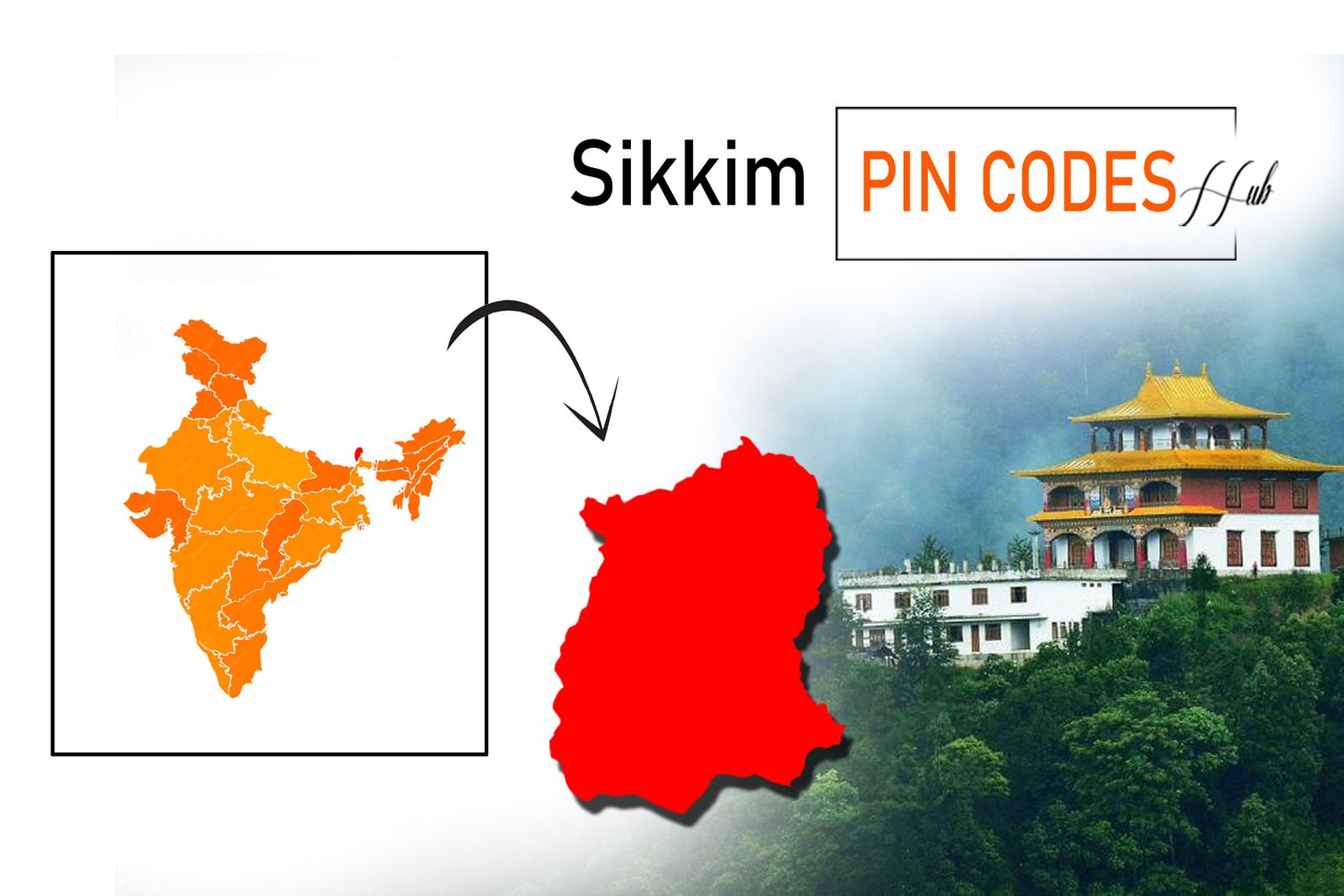
22. Sikkim PIN codes: Complete 6 Districts

Complete Guide to Sikkim PIN Codes

Sikkim is one of those places that feels different the moment you hear its name. It’s not just another state on the map of India—it has a calm presence, something that makes it stand apart. Surrounded by mountains, covered in greenery, and filled with quiet towns and peaceful villages, Sikkim carries a sense of balance that is hard to describe unless you experience it.

Located in the northeastern part of India, Sikkim is the second smallest state in the country, but what it lacks in size, it makes up for in uniqueness. Life here moves at a different pace. There are no crowded metro cities or overwhelming traffic like in bigger states. Instead, you find winding roads, misty hills, small markets, and communities that are closely connected.

But even in a place that feels simple and natural, there is a system working quietly in the background that keeps everything connected—the PIN code system.

At first glance, PIN codes might not seem important. Most people just write them at the end of an address or enter them while ordering something online. But in a state like Sikkim, where geography itself can be challenging, these six digits play a much bigger role than people usually realize.

They don’t just identify a location—they connect it.

Sikkim

A Simple Way to Understand PIN Codes

The PIN code system in India was introduced to bring order to postal services. Before it came into use, there was often confusion, especially when different towns or villages had similar names. Letters would sometimes go to the wrong place or take longer than expected to arrive.

To solve this, a six-digit system was created. Each digit has a meaning, and together they form a clear path for delivery.

In Sikkim, PIN codes usually begin with the number 7, which represents the northeastern region of India. As the digits continue, they narrow down the location step by step—from region to district and then to the specific post office.

You can think of it like directions on a map. Instead of writing long descriptions, these numbers guide the process in a simple and structured way. Even if part of the address is unclear, the PIN code often helps in correcting the route.

For postal workers, this system reduces confusion. For people, it ensures that letters, parcels, and documents reach the right place without unnecessary delays.

Why PIN Codes Matter More in Sikkim

In many states, roads are wide, cities are large, and transportation is easy. But Sikkim is different.

Here, you have:

  • Mountain roads instead of highways
  • Small villages instead of large urban areas
  • Weather conditions that can change quickly
  • Locations that are sometimes far from main routes

Because of all this, delivering something from one place to another is not always simple. Without a proper system, it would be very difficult to manage communication and deliveries.

That’s where PIN codes become important.

They help:

  • Identify exact locations
  • Avoid confusion between similar place names
  • Support faster sorting of mail
  • Improve delivery accuracy

Even in remote areas, a PIN code ensures that the location is part of a larger network. It brings even the most distant village into the system.

Daily Life and the Use of PIN Codes

Today, PIN codes are not limited to postal services. They are used in many parts of daily life, often without people noticing how important they are.

In Sikkim, PIN codes are commonly used for:

  • Ordering products online
  • Filling out bank forms
  • Applying for jobs and exams
  • Registering for government schemes
  • Receiving official documents

Imagine someone living in a small village on a hillside. They may not have access to large shopping centers or services nearby. But with the help of a PIN code, they can order items online and receive them at their doorstep.

This simple system helps reduce the gap between remote areas and the rest of the country.

How Sikkim Is Structured Through Its Districts

Sikkim is divided into a few districts, each with its own character and landscape. Even though the number of districts is smaller compared to larger states, each one has a well-organized set of PIN codes.

East Sikkim

East Sikkim is one of the most developed parts of the state. It includes Gangtok, the capital city.

This district has a higher number of PIN codes because of its population and activity. Government offices, businesses, and residential areas all rely on the system for smooth communication.

West Sikkim

West Sikkim is quieter and more scenic. It is known for its natural beauty and peaceful environment.

The PIN code system here connects small towns and villages, ensuring that even less populated areas are included.

North Sikkim

North Sikkim is one of the most remote and least populated regions. It has extreme weather conditions and difficult terrain.

In such areas, the PIN code system becomes even more important. It helps maintain a clear structure for deliveries despite the challenges.

South Sikkim

South Sikkim has a mix of small towns and growing areas. It is less crowded than the east but still active in terms of daily life.

The PIN codes here support communication between different parts of the district and connect them with the rest of the state.

Sikkim District PIN Code Overview

S.No | District | PIN Code Range
1 | East Sikkim | 737101 – 737136
2 | West Sikkim | 737111 – 737121
3 | North Sikkim | 737116 – 737120
4 | South Sikkim | 737102 – 737139

These ranges may look simple, but they cover the entire state. Each PIN code within these ranges represents a specific post office and the areas connected to it.

Major Locations and Their PIN Codes

To make things more practical, here are some commonly known places in Sikkim and their PIN codes:

These are some of the key locations where people often need accurate PIN codes for deliveries or official work.

Postal Services Beyond Letters

In earlier times, post offices were mainly used for sending and receiving letters. But today, their role has expanded significantly.

In Sikkim, especially in smaller towns and villages, post offices provide:

  • Savings account services
  • Money transfers
  • Insurance options
  • Distribution of government benefits

For many people, the post office is more than just a place to send mail. It is a trusted center for financial and official services.

Sikkim District PIN Code Overview:


1 East Sikkim 737101 – 737135
2 West Sikkim 737121 – 737136
3 North Sikkim 737116 – 737120
4 South Sikkim 737126 – 737139
5 Pakyong 737106 – 737107

6 Soreng 737121 – 737122

The PIN code system helps organize all these services, making sure they reach the right people.

The Role of PIN Codes in Online Shopping

With the growth of online shopping, PIN codes have become even more important.

Whenever someone places an order, the first thing that gets checked is the PIN code.

In Sikkim, this has made a big difference. People who live in remote areas can now access products that were once difficult to find locally.

The PIN code helps companies:

  • Confirm delivery availability
  • Plan delivery routes
  • Estimate delivery time
  • Manage logistics efficiently

Without this system, it would be difficult for companies to handle deliveries in a region with such unique geography.

Challenges in a State Like Sikkim

Sikkim’s natural beauty comes with its own challenges.

Some of the common difficulties include:

  • Mountain terrain that slows down travel
  • Landslides during rainy seasons
  • Limited road access in certain areas
  • Weather conditions affecting transportation

These factors can sometimes delay deliveries. But even in such situations, the PIN code system ensures that the destination remains accurate.

It acts like a stable guide, even when conditions are not ideal.

A System That Works Quietly

One of the interesting things about PIN codes is that people rarely think about them unless something goes wrong.

When everything works smoothly, no one notices the system behind it. But the moment there is a delay or mistake, its importance becomes clear.

In Sikkim, this system has adapted over time. It continues to support communication, deliveries, and services across the state.

It may not be visible, but it is always active.

Common Mistakes People Make with PIN Codes

Even though PIN codes are simple, small mistakes can create problems.

Some common issues include:

  • Writing the wrong PIN code
  • Leaving it blank in forms
  • Mixing up nearby area codes
  • Assuming all nearby places have the same code

These mistakes can lead to delays or confusion. That’s why it’s always better to double-check before using a PIN code.

How to Find the Correct PIN Code

If you are not sure about a PIN code, there are simple ways to find it:

  • Visit the nearest post office
  • Check official postal websites
  • Ask local residents or shopkeepers
  • Look at previous letters or documents

Taking a few extra seconds to confirm the correct code can save a lot of time later.

Sikkim Frequently Asked Questions (FAQs)

1. Why do Sikkim PIN codes start with 7?
Because it belongs to the northeastern postal region of India.

2. Can multiple areas share the same PIN code?
Yes, especially in regions where one post office serves multiple locations.

3. Is it necessary to include the PIN code?
Yes, it helps ensure faster and more accurate delivery.

4. Do remote villages in Sikkim have PIN codes?
Yes, they are connected through nearby post offices.

5. Can a wrong PIN code delay delivery?
Yes, it may take longer or even reach the wrong place.

6. Are PIN codes used outside postal services?
Yes, they are used in banking, online shopping, and registrations.

7. Do PIN codes ever change?
Changes are rare but possible if new post offices are created.

8. Are city PIN codes different from village ones?
Cities usually have more codes, while villages may share them.

9. How important are PIN codes for online delivery?
They are essential for determining delivery availability and timing.

10. Can I find a PIN code without the internet?
Yes, by visiting a local post office.

Sikkim Conclusion

The PIN code system in Sikkim may seem simple, but it plays a powerful role in connecting the state.

From the busy streets of Gangtok to quiet villages in the mountains, every place is linked through this system. It supports communication, helps services reach people, and keeps everything organized.

Even in a region where geography creates challenges, these six digits bring clarity and structure.

They may not be noticed every day, but they quietly ensure that everything runs smoothly.

In the end, a PIN code is more than just a number. It is a connection—a small but essential part of everyday life that keeps people, places, and services linked together across Sikkim.

Leave a Comment